Platform overview
One operating system for youth, family, workforce, and community impact.
Every BridgeCase module reads and writes the same connected records. A mentoring session, an approved timesheet, and a completed referral all land on the same participant profile — so nothing has to be reconciled later.
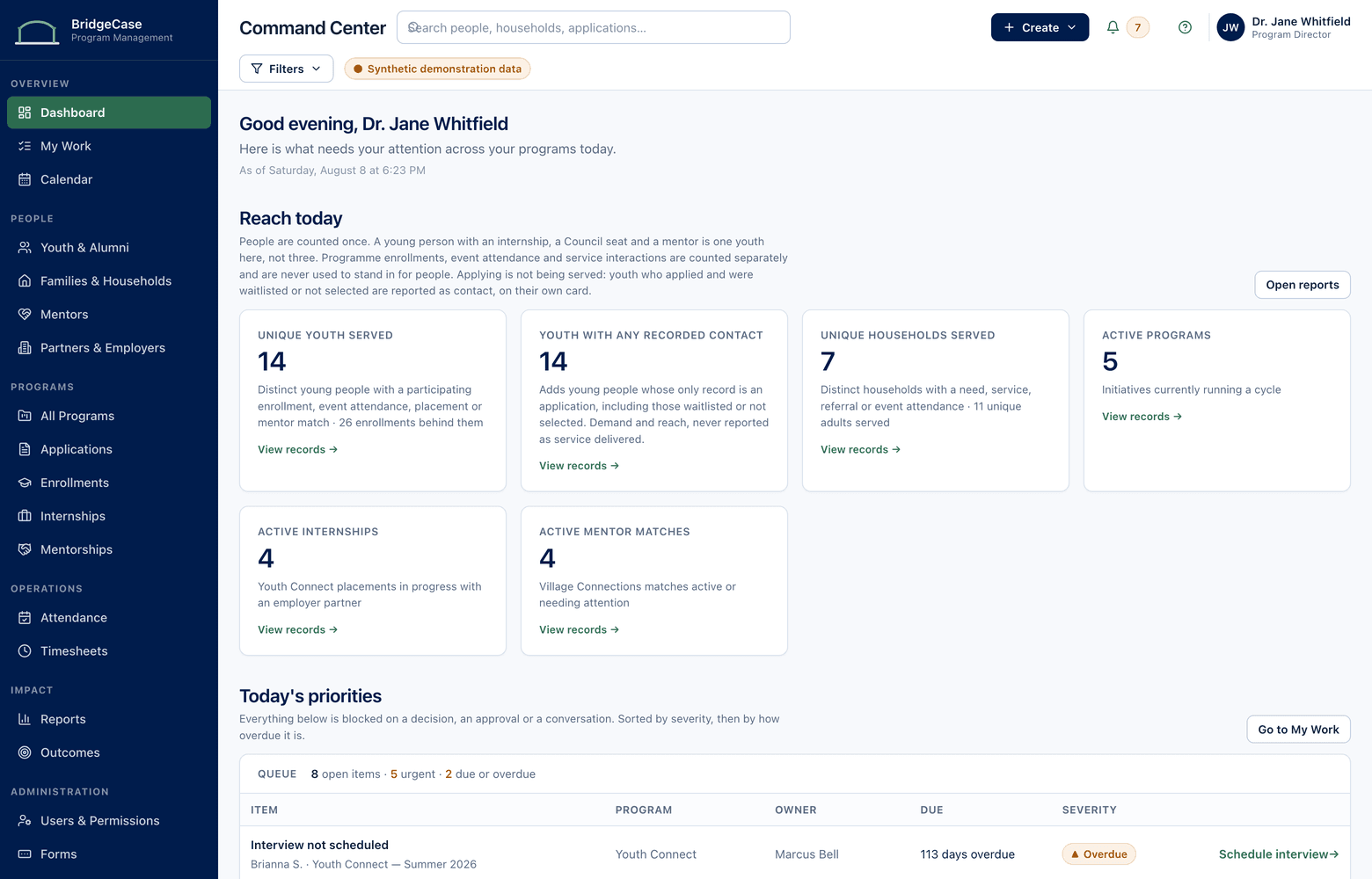
The data model
One person. One household. Many programs.
This is the difference between a platform and a bundle of modules. Each person has one permanent profile; each family has one household record connecting guardians, siblings, needs, services, referrals, and communications. Every module builds on those records instead of creating its own copies.
Because the record is longitudinal, a participant who joins the youth council at 14, gets matched with a mentor at 15, and completes an internship at 17 is still one person in your annual report — with a history your staff can actually see.
Core modules
Eight modules, one shared foundation.
Use what you need now and turn on more as programs grow — everything stays connected either way.
Participant & Household 360
One longitudinal record for every person and household
Learn morePrograms, Intake & Enrollment
Applications, interviews, cohorts, and enrollment
Learn moreMentoring
Recruiting, screening, matching, sessions, and goals
Learn moreWorkforce & Internships
Employers, placements, timesheets, and evaluations
Learn moreFamily Resources & Referrals
Household needs and closed-loop referral tracking
Learn moreOutcomes & Reporting
Reports for leadership, boards, councils, and funders
Learn moreSecurity & Governance
Role-based access, audit history, and data ownership
Learn more
Configurability
Configure without rebuilding.
Organizations differ in programs, forms, statuses, and vocabulary — not in their need for connected records. BridgeCase is configured, not forked: there is no separate codebase per customer.
- Programs and cohorts
- Model each program's stages, sessions, and cohorts without custom development.
- Forms and fields
- Build intake, application, and assessment forms with your own questions and logic.
- Statuses and workflows
- Define the stages work moves through — and what happens at each one.
- Roles and permissions
- Decide exactly which roles see, edit, and export which records.
- Terminology
- Call participants, mentors, and programs what your organization calls them.
- Reports
- Configure report definitions once; reuse them every grant period.
Workflow automation
The system remembers, so staff don't have to.
Follow-up shouldn't depend on whoever has the best memory. BridgeCase turns program rules into automatic tasks and reminders.
- Tasks created automatically when an application advances, a clearance nears expiration, or a referral stalls
- Reminders for missing documents, unsigned consents, and overdue follow-ups
- Timesheet submission and approval routing between participants, employers, and staff
- Notifications that respect each role's permissions — no sensitive data in a casual email
Reporting & evidence
Reports built from source records.
Attendance, sessions, hours, services, and referrals feed reporting the moment they're recorded. Unique people, unique households, enrollments, services, and outcomes each have clear definitions — so your board number and your grant number finally agree.
Governance is part of the platform, not an add-on.
Role-based access, restricted notes, consent tracking, audit history, and export controls apply across every module — because they live in the shared foundation.
Explore security and governance- Role-based access
- Restricted notes
- Consent tracking
- Audit history
- Export permissions
- Data ownership
Implementation starts with your workflows, not our defaults.
Discover, configure, import approved data, train, launch — scoped to your programs and reporting obligations.
See what one connected system could look like for your organization.
We will tailor the conversation to your programs, users, reporting needs, and current tools.
No youth or family data is required to request a demo.